

Educators’ Science Competencies in Early Childhood Education and Care
This PhD study draws on empirical data from NAVADA’s main project and investigates the competencies and professional knowledge that educators employ when establishing and developing science-oriented play and learning environments in early childhood education and care (ECEC) settings.
The study contributes an important dimension to the overall NAVADA project by examining how educators themselves describe their professional expertise and competencies in relation to science, as well as the reflections and considerations that inform their practice. Over a two-year period, Karen Bollingberg conducted ethnographic fieldwork by following educators’ participation in NAVADA activities, including science camps, science laboratories, activities within their own institutions, and professional development days. Through ongoing observations, informal conversations, questionnaires, and various forms of interviews, Bollingberg generated empirical material that enabled educators themselves to articulate how they apply their professional expertise in science education and what they consider important in this work.
One of the study’s central findings is that, through the structure and facilitation provided by researchers within the NAVADA programme, educators come to recognise and draw upon their general pedagogical expertise when developing science-oriented play and learning environments. Prior to participating in the programme, many educators described feeling uncertain about how to work with science in ECEC settings and believed that they lacked the necessary scientific knowledge. Over time, however, they reported becoming more capable of recognising and acting upon situations with science potential, perhaps because they were drawing on an unacknowledged form of science capital that they had previously not recognised in themselves.
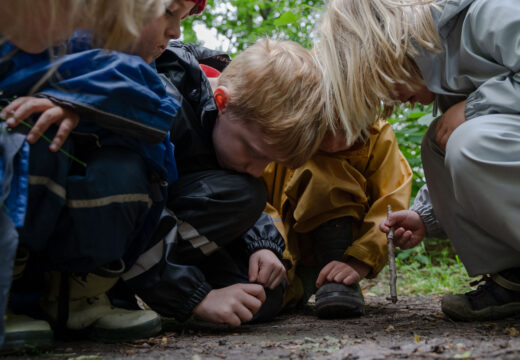
At the same time, educators expressed that they began to engage with children’s perspectives in new ways by placing children’s curiosity at the centre of their pedagogical practice, even when this challenged existing institutional logics and established routines. In their work with play and learning environments, educators became increasingly aware of the importance of spontaneity, unpredictability, and a willingness to relinquish control over planned activities in order to follow children’s interests and inquiries. They described facilitating processes that support children’s immersion and spontaneous explorations of the world, where the learning process becomes more important than the final product. Within these processes, children and educators jointly explore selected themes and collaboratively construct scientific knowledge.
Overall, the findings of the PhD study suggest that participation in the project leads educators to transform their understanding of what science can be in ECEC settings. As a result, they come to see themselves as both capable of and motivated to engage with science education, despite feeling that they lack specialised scientific expertise. By drawing on the science knowledge and skills they already possess, alongside their broader pedagogical competencies and professional expertise, and by viewing the world through children’s eyes, educators also expand their own understanding of science.
Karen Bollingberg hopes to bring these insights into the Early Childhood Teacher Education programme, where she teaches, thereby inspiring and empowering future educators to engage confidently and enthusiastically with science pedagogy.