

Emergent Mathematical Attention in Early Childhood Education and Care Play and Learning Environments
Since January 2023, PhD researcher Søren Krogh Hansen, as part of the NAVADA research programme, has investigated the phenomenon of mathematical attention. In his forthcoming monographic doctoral dissertation, Emergent Mathematical Attention in Early Childhood Education and Care Play and Learning Environments, Hansen explores a hitherto unexamined field within science education: the significance of mathematical attention in Danish early childhood education and care (ECEC).
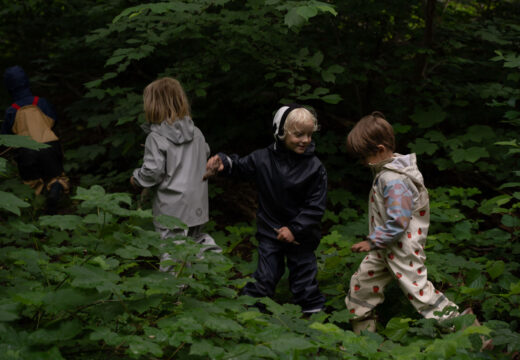
The concept of emergent mathematical attention originates from the curriculum theme Nature, Outdoor Life and Science. As part of the Danish Daycare Act of 2018, the strengthened pedagogical curriculum framework identifies supporting children’s scientific literacy as a key educational objective, enabling children to “gain experiences in recognizing and expressing cause, effect, and interrelationships, including an emergent mathematical attention.” However, the ways in which the phenomenon of mathematical attention is enacted in ECEC play and learning environments have not previously been empirically investigated or described. It is precisely this gap that Hansen seeks to address in his dissertation.
The PhD project constitutes a contribution to mathematics education research within the Danish ECEC field and aims to broaden prevailing understandings of mathematics beyond the scholastic and conceptual forms of mathematics traditionally associated with mathematics education in Danish compulsory schooling. Through a revitalization of the pedagogical concept of attention, the project investigates the mathematical possibilities embedded within ECEC practices. The concept of attention has deep historical roots, extending back to the earliest Danish kindergartens and later traditions of Danish nature pedagogy.
Methodologically, the research employs a movement-oriented sensory ethnographic approach. As a participant observer in children’s everyday lives within ECEC settings, the researcher documents through field notes, audio recordings, photographs, and collected artefacts how children, through their attentional engagements, materially engage with and are engaged by sociomaterial interactions within pedagogical environments. The empirical findings suggest that children’s mathematical attention concerns more-than-mathematics. Sticks, traffic signs, rhubarb plants, pavements, forest paths, park valleys, gates, tables, raised garden beds, and other material features invite mathematical forms of engagement through their interaction with children’s attentional practices.
A stick extends a child’s reach into the world. Traffic signs establish counting rhythms through their interaction with children’s hands. The growth of rhubarb in a raised garden bed becomes a matter of length, height, and quantity when harvested and transformed into rhubarb compote. Running repeatedly through the curved contours of a park valley is an engagement with curves, again and again, often without a single spoken word beyond the small cry of excitement accompanying each run. This is not mathematics in the conventional school-based sense. Rather, it represents something qualitatively different and more expansive from a mathematics education perspective.
Mathematical attention emerges as relational, spatially oriented, and rhythmic. Collectively, it is most often enacted implicitly as more-than-mathematics: an integral aspect of the sensory, embodied, and tangible practices of everyday life.
The project is not concerned with locating mathematics within the everyday life of ECEC settings. Instead, it investigates how attention is practiced within the relationships between children and their environments, and how something mathematical emerges through these relations. Such an inquiry requires methodological proximity and attentiveness to the often unnoticed dimensions of everyday life, including those phenomena that at first glance appear entirely non-mathematical.
Hansen’s research provides a foundation for establishing an applied and practice-oriented field of mathematics education research for Danish ECEC. Furthermore, it points toward a participatory, practice-near, life-affirming, dialogical, and sustainable direction for future research on mathematical attention. Mathematical attention in early childhood education and care is fundamentally concerned with more-than-mathematics rather than with the mathematics of schooling.